Skip to Content

CURRENT EXHIBITS:


Signed Publishers' Bindings

Third-floor Rotunda gallery and one case at Swem entrance

June 20-indefinite

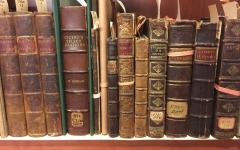
Book lovers who appreciate the glory of a beautifully-decorated binding will rejoice in Swem Library's new exhibit, featuring publishers' bindings.   This exhibit features bindings designed by Margaret Armstrong, George Edwards, John Feely, Theodore Hapgood, Alice Morse, and Sarah Whitman.  All the volumes on display are from either the collections of Swem Library or Merle Kimball, Serials and Preservation Librarian, the curator for the exhibit.

The advance of technology in the nineteenth century enabled publishers to advertise the books they published by adding designs to the front covers. The design had to be drawn and engraved on a plate to be stamped on the binding which was usually cloth or leather. The English and American publishers discovered that gold would adhere to the cloth so they began using it on covers in the 1830s. By the 1880s, they began to use other colors and the covers were becoming more decorative. As the cost of producing books declined, publishers hired designers and artists to decorate the covers.

The most active period of designed covers was between 1890 to the 1920s. The American publishers were prolific in using decorated trade bindings, along with the British. The large majority of designed covers were done for fiction. A number of women artists designed covers and other items. It was an acceptable employment for women. Other countries did not use cover designs as much as the British and American publishers.

Some of the more prolific artists put their initials on the covers to identify it as their work. Many more designed bindings were done but they were not signed. Even the artists who signed a design did not always do it for all the covers they designed. Publishers’ bindings were superseded by illustrated paper book jackets. It was more economical for the publisher to use book jackets rather than having designs printed on the volume.


From The ’Burg To Berlin And Beyond: World War II At Swem Library

Nancy Marshall Gallery (Rotunda) and SCRC

Hours for the Marshall Gallery

Hours for the SCRC

Please note, the Marshall Gallery is open whenever Swem is open, while the cases in the SCRC are open only when the SCRC is open.

April 28-September 14, 2008

Swem Library at the College of William and Mary presents the exhibit, “From the ’Burg to Berlin and Beyond: World War II at Swem Library.”  Using letters, diaries, posters, photographs, sheet music, and other materials from Swem’s Special Collections Research Center, the exhibit provides a general overview of the War, with a special emphasis on the College and Williamsburg.  The first four sections of the exhibit are in the Marshall Gallery; the remainder are in the SCRC.

The first section looks at the beginning of World War II in Asia and Europe through Pearl Harbor.  Among items on display are photos and papers relating to Albert Raymond, an American in Paris who volunteered as an ambulance driver after Germany invaded France.  The attack on Pearl Harbor is recalled through the reminiscences of William and Mary alumni who were on campus at the time.  A scroll contains Japan’s declaration of war on the U.S. in Japanese characters, with an accompanying English translation.

The next two sections explore the War at the College and in Williamsburg.  Photos show naval chaplains and soldiers at the College and on parade on Duke of Gloucester Street, while war ration books and USO materials testify to civilian contributions to the war effort.  An issue of the Bee Line, Camp Peary’s newspaper, and letters by Williamsburg residents further illuminate local wartime experiences.

The fourth section focuses on those in uniform.  Highlights include letters home by nurses in Burma and Normandy, a photo album and Christmas menu for a hospital commanded by W&M alumnus Colonel Amos Koontz, and telegrams congratulating local hero and W&M alumnus Admiral John Lesslie Hall, Jr., for his successful supervision of the Normandy landings.  W&M education professor emeritus Armand Galfo, who served as an airman, is represented by V-mails and a silk map with tiny bombs marking the locations his plane attacked. 

The next section examines the end of the War and its aftermath.  Photos of President Roosevelt’s funeral are accompanied by a letter lamenting his death written by a Sea Bee at Camp Peary.  Other notable items include a photo of Tojo on trial in Tokyo and the prosecution’s opening statement in the Japanese war crime trials, photos of the devastation in Hiroshima and Europe, and a publication created by German civilians interned by the Allies as suspected Nazis. 

The final three cases investigate specific issues or events of the war years.  One case looks at the internment of Japanese and Japanese-American civilians in the U.S. and an anti-Fifth Column vigilante group operating in Montclair, New Jersey.  Another case looks at the Holocaust, with original photographs of the dead at Dachau, letters by people in the United States reacting to news of the camps, and a facsimile of Hitler’s last will, where he still blames the Jews for his problems.  The last case recalls a wartime controversy at William and Mary, when Marilyn Kaemmerle, the editor of the student newspaper, called for an end to segregation and was fired.

It's All Greek To Me

Read and Relax flat case

Social fraternities and sororities have played an important part in student life at the College of William and Mary for over 150 years. The student group F.H.C. was founded in 1750 as the first secret society in the Americas and was the forerunner to fraternity life at William and Mary. America’s first Greek letter society, Phi Beta Kappa, was also founded at the College in 1776. The first social fraternity chartered on campus was Theta Delta Chi in 1853, and by 1907, there were five fraternities on campus. After women entered the college in 1918, Chi Omega became the first sorority chartered in 1921. In 2007, there were 16 recognized fraternities and 12 sororities on campus. As of January 2008, 22% of undergraduate men and 28% of undergraduate women were in either a fraternity or sorority at the College. The exhibit It's All Greek To Me showcases a selection of fliers, artifacts, yearbooks, and other material from the University Archives documenting Greek Life at the College.


The College in Song

Front lobby flat case

The College in Song is the new student life exhibit using material  from the University Archives in the Special Collections Research  Center, Swem Library. Students have been singing at the College of  William and Mary for years. The items on display include a selection  of fliers, programs, CDs, t-shirts, props, and other material from  student singing groups highlighting the variety of genres and groups  currently performing on campus. The University Archives actively  collects material in a variety of formats from student groups. We urge  current students and organizations to consider giving material to the  University Archives to ensure that future students and researchers  have access to these rich sources of information about students and  student life at the College. The exhibit case is located in the lobby  area.


Commencement

Front lobby flat case

The annual Commencement exhibit marks the tradition of exercises for graduates of the College of William and Mary first held in 1700 and the awarding of honorary degrees. Honorary degrees were granted by the College sporadically through the mid-19th century before becoming a regular campus tradition and eventually awarded annually since the early 20th century. William and Mary alumni Mike Tomlin, Pittsburgh Steelers head coach and a member of the Class of 1995, and Rabbi David Ellenson, president of the Hebrew Union College-Jewish Institute of Religion and member of the Class of 1969, will receive honorary degrees at the 2008 commencement ceremony. Tomlin will deliver the commencement address. The exhibit case is located in the lobby area.


Earth Visions/Visiones Terrestres

Botetourt Gallery, March 20-May 31

Earth Visions/Visiones Terrestres is an exhibit of original poetry and photography by W&M students, faculty, staff, alumni and friends.   Contributions bring into dialogue perspectives from the Arts and Sciences on environmental issues in the Americas. The exhibit opens March 20 in the Botetourt Gallery, Earl Gregg Swem Library and runs through May 31, 2008.


The Warren E. Burger Office

Special Collections Research Center

The SCRC is  home to the papers of the late Warren E. Burger, Chief Justice of the Supreme Court.  While the collection will not be open to researchers for many years, the SCRC does have an exhibit re-creating the atmosphere of his office.  Many objects actually used by Burger are on display in the Burger Office on the first floor of the SCRC.  For more information and photographs, please see the Warren E. Burger Online Exhibit .


Title Pages: Department of History Faculty Publications

Bright Gallery

The second of a series of library exhibits of W&M faculty publications opened in Swem Library in the fall of 2008. The exhibit features over fifty books written by the faculty of the Department of History as well as related letters, reviews, and awards. The volumes in the exhibit are on loan from the University Archives and second copies are available in the circulating collection.

The exhibit is located in the Bright Gallery in the second floor rotunda of the east wing of the library and will run through May, 2008. Visitors will be impressed by the many hours of research and scholarship represented.


Little Magazines

Third floor Rotunda Gallery

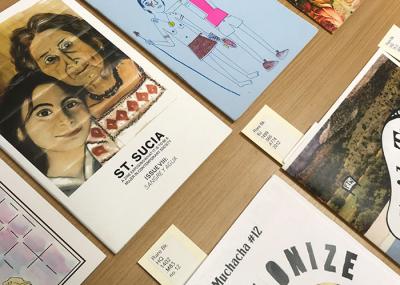
Little Magazines opened in the Third Floor Rotunda Gallery in September 2007. Little magazines come in all sizes and shapes but have limited print runs.  The exhibit features an eclectic collection of little magazines, many with non-mainstream viewpoints.  Some of the magazines are from the SCRC; others, from the regular stacks. This exhibit will be open indefinitely.